
A day in the life of MSP Airport's Emergency Communications Center
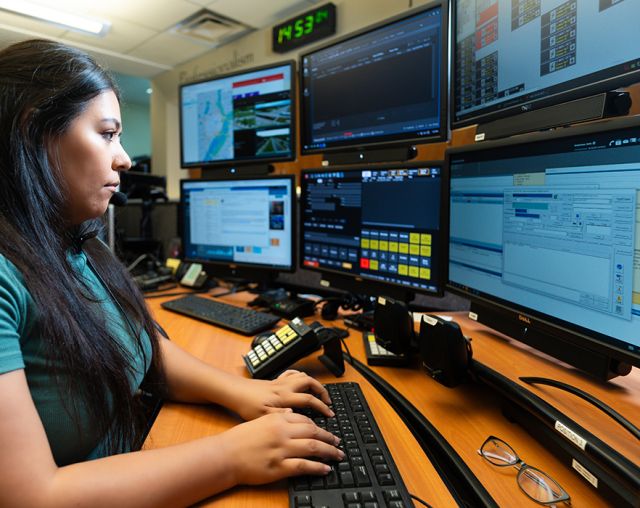
Always on at the ECC
The day shift at the Metropolitan Airports Commission’s (MAC) Emergency Communications Center (ECC) begins promptly at 6 a.m. The ECC is never truly quiet, but the handoff between the night shift and the incoming crew is a moment of transition. The outgoing emergency communications specialist (ECS) provides a rundown of anything the next team needs to know; systems being worked on, alarms that have been acting up, equipment notes, ongoing incidents or units to keep an eye on. Once that’s complete, headsets go on and the day officially starts.
6-7 a.m.: Early Administrative Load
Before the day’s activity picks up, administrative calls begin to trickle in. The Customer Engagement office isn’t open yet, but that doesn’t stop early requests from arriving. Other administrative calls come from contractors or maintenance teams giving notice that their work may cause alarms — plumbers setting off waterflow alarms, technicians scheduled to test pieces of the fire system.
An airport employee may report a lost security badge. The MSP Badging Office isn’t open yet either, so the specialist handles the immediate security concern by deactivating the badge and documenting their actions.
The 911 Line Never Waits
Interspersed with administrative calls are the true emergencies. A medical call on a concourse at MSP Airport, an unconscious passenger, a fall on the escalators, a traveler short of breath near baggage claim, or an unattended bag. Each 911 call is handled with calm precision: gather information, dispatch the appropriate fire or police units, relay updates and guide callers until help arrives.
8 a.m.: The daily CRASH phone test
Every morning at 8 a.m., the Air Traffic Control Tower initiates the daily CRASH phone test. This phone connects the Tower directly to the ECC for aircraft emergencies. The specialist confirms the tower audio and that the Airport Fire Department can hear it in both stations. The test might only take a minute, but its reliability could save lives when seconds matter.
Immediately following the CRASH test, the ECC conducts a radio test with the fire department. Clear radio communication is non‑negotiable.
Mid-morning: the unexpected mix
The airport is fully awake now, and with it comes a steady rotation of 911 and administrative calls and alarms:
• A license plate recognition (LPR) system notes a stolen vehicle on the inbound roadway. The ECC processes the alarm, dispatching officers to search for the vehicle. They immediately begin checking closed circuit TV (CCTV) to locate the vehicle.
• A fire alarm activation in the terminal. It could be smoke, a contractor, or a malfunction, but the ECS treats each one as a priority until confirmed otherwise. Police and fire are dispatched and CCTV is checked for signs of fire.
• Held or forced door alarms blink across the console. Each one must be investigated: it could be a rushed employee, a gust of wind, or a security violation that requires a police investigation.
Despite hundreds of thousands of people moving through MSP, the ECC keeps every thread connected.
Afternoon: The call that changes the tempo
At any moment, the CRASH phone can ring with the control tower advising us of an Alert 2, a potential aircraft emergency — serious enough to require full coordination of police, fire and emergency medical services (EMS) personnel.
As quickly as it began, the alert may resolve safely. Or it may not. The specialist is ready either way.
1800: Shift Change
As the day shift hands consoles off to the evening crew, they recap everything that unfolded; alarms still open, equipment failures, unusual calls, upcoming tests, any units still active on scenes. Some days are routine. Some days are heavy. All of them require sharp attention, calm communication and an ability to pivot without hesitation.
For an emergency communications specialist at the MAC, every shift is different, but the mission is always the same: Every responder, every customer, every time, with pride, passion and excellence.
Did you know?
-
The State of Minnesota has more than 100 Public Safety Answering Points, also known as Emergency Communications or 911 Centers, always available to answer 911 calls. As part of the statewide network, MSP Airport has its own dedicated ECC.
-
The MSP Airport ECC is staffed 24/7 by ECS’s. They are responsible for answering 911 calls and any administrative calls received by dialing 612-726-5577. Dialing either number routes callers to an ECS, but they prioritize answering 911 calls before the administrative lines.
-
In an emergency, dial 911. An emergency is any situation that requires an on-scene response from a police officer, fire department, or ambulance. If you’re unsure if the situation is an emergency, call 911 and the dispatcher will ask you questions to help determine if a response is needed.
-
In Minnesota you can text 911 for emergency help. In some areas cellular coverage may prevent dialing outbound calls, but texting services are still supported. Text 911 when calling isn’t available, or when you find yourself in an unsafe situation where silence keeps you safe.
-
When you call 911 be prepared to answer the dispatcher’s questions. Each of the dispatchers at the MSP Airport ECC are trained Public Safety Telecommunicators (PSTs) who will ask you important questions to get the right kind of help to you quickly. Depending on the situation, the dispatcher you are speaking with will be relaying information to their partners to get help started while continuing to ask additional questions. Answering the questions doesn’t slow the response.
-
The ECC is both a 911 center and real-time information center. The ECC staff not only manage emergency calls and dispatch frontline responders, but they also monitor over 4,000 cameras, the door access system and the largest fire alarm system in the state of Minnesota.
-
When you call 911 the dispatcher will ask for location information. Terminal 1 is approximately 2.8 million square feet (just over 48 football fields), and the dispatcher understands that you won’t have an exact address for your location. They will ask you to provide any landmark info, like a gate or door number or the name of any nearby businesses. The important thing to remember when you call 911 is to stay calm. The dispatcher will make sure they use all the tools available to them to get the right help to the right location quickly.