MSP Airport’s economic impact grows to $21.3 billion annually


MSP Airport’s economic impact grows to $21.3 billion annually
February 05, 2026
New study shows total economic output has more than doubled since 2012
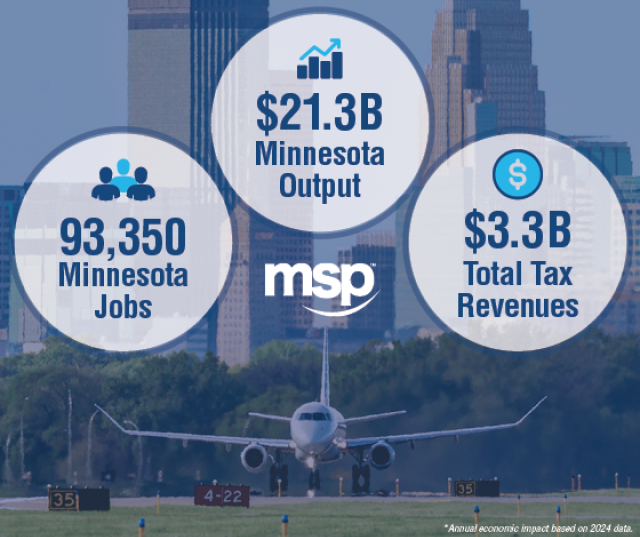
A new report shows Minneapolis-St. Paul International Airport (MSP) has greatly expanded its presence as an economic generator in the Twin Cities and state of Minnesota in recent years. As Minnesota’s largest commercial airport, MSP supports a total economic impact of $21.3 billion in output annually.
A newly released analysis by InterVISTAS Consulting Inc. shows that MSP supports more than 93,000 total jobs and contributes $3.3 billion in local, state and federal government revenues. The study, commissioned by the Metropolitan Airports Commission (MAC) — owner and operator of MSP — looked at MSP’s daily operations, capital investments and associated spending by visitors who traveled through the airport.
“As MSP facilitates more global connectivity for Minnesotans, it has accelerated direct, indirect and induced economic benefits across the Twin Cities and the state,” said Brian Ryks, CEO of the MAC. “Recent air service growth and operational investments are making impacts beyond the immediate benefits of global travel. MSP is creating jobs, boosting business, sustaining tourism and elevating hospitality — all to help Minnesota thrive.”
The study provides a new economic snapshot, based on 2024 MSP activity data, offering an update to previous studies in 2016 and 2012. In the 2024 study year, MSP was the 17th busiest passenger airport in the United States, serving 37.2 million total passengers and supporting approximately 342,000 airline and other aircraft operations. The study also confirms MSP’s strong recovery from the COVID-19 pandemic following the airport’s record of 39.6 million total passengers in 2019.
MSP’s total economic output of $21.3 billion in 2024 is notably higher compared to previous studies — up 34% from 2016 ($15.9 billion) and more than double the 2012 level ($10.1 billion). MSP’s total employment impact of 93,350 jobs is also higher, rising 7% since 2016 (86,900) and 22% since 2012 (76,340).
Following is a summary of impacts by key categories:
Jobs
MSP supports 93,350 direct, indirect and induced jobs across multiple industries. Of those, 49,250 jobs are directly connected to airport operations, capital improvements and tourism facilitated by air service. The study found MSP directly supports more than 24,380 jobs at the airport itself, with 52% (12,750) from employment by air passenger carriers. The second-largest direct employment sector is aviation support jobs (ground handling, aircraft repair, fueling and other services), comprising 17%. The airport’s food, retail and hospitality-related businesses account for 12% of direct jobs, the third-most at MSP.
The airport also supports 18,830 indirect jobs (supplier businesses) and 25,260 jobs induced by employee spending.
Airport construction
Beyond airport operations, one-time capital improvements provide additional economic impacts. Average annual capital expenditures from 2022 to 2024 were around $286 million, and approximately $213 million was spent in state each year. In total, MSP capital expenditures created an estimated $400 million in economic output and $170 million in labor income. Large-scale modernization projects included in the study were the expansion and modernization of pre-security areas of Terminal 1, the interior makeover of Terminal 1 concourses, and the ongoing project to expand Terminal 1’s Concourse G between gates G8 and G13.
Visitors
In 2024, MSP welcomed approximately 4.7 million visitors to the Twin Cities (98% via scheduled commercial air carriers). In total, visitors arriving via MSP spent nearly $3.4 billion in Minnesota, with domestic visitors spending almost $3.2 billion and international visitors spending roughly $203 million. Domestic visitors spend approximately $720 per trip and stay 4.5 nights on average, while international visitors spend around $990 per trip and stay for about 6.3 nights.
Tax revenues
Altogether, total tax revenues attributable to MSP (including direct, indirect and induced impacts) reached nearly $3.3 billion in 2024. Approximately 51% of this were contributions to federal taxes, while 32% went toward state revenues, primarily through state sales taxes. The remaining 16% percent was attributable to local government revenues.